

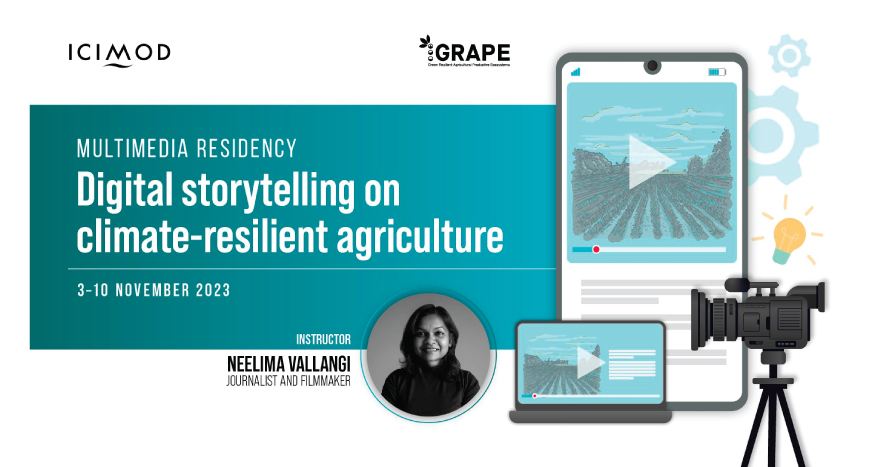
Apply for Digital Storytelling Training On Climate-Resilient Agriculture 2023 by ICIMOD
In order to solve the problems caused by climate change and ensure sustainable food production, climate-resilient agriculture employs a holistic approach that combines straightforward, reasonably priced, and naturally based solutions with cutting-edge technology. By emphasising resource efficiency, conservation, emission reduction, and biodiversity protection, it promotes sustainable farming practises. This strategy encompasses cutting-edge practises including biological pest control, biological fertilisation, conservation agriculture, crops that can withstand drought, a cropping system that can withstand climate change, digital agro advising services, and cutting-edge weather forecasting systems. Climate-resistant agriculture has a lot to offer farmers. It lessens the possibility that crops would fail because of harsh weather conditions or shifting growth seasons. Resilient farming techniques optimise yields, resulting in more steady profits. As a result, farmers are less susceptible to losses brought on by the weather in terms of financial hardship. Furthermore, by supporting sustainable agricultural practises, climate-resilient agriculture benefits both farmers and the environment.
Journalists will be given the tools they need to effectively communicate the serious issues of climate change and resilience building through an in-person, intensive multimedia residence with a focus on climate-resilient agriculture. To help them confidently create compelling digital climate change stories, journalists will be exposed to the fundamentals of climate science as well as the complexities of good storytelling and video story production techniques. Participants are required to create a top-notch digital story about climate adaptation and climate-resilient agriculture at the conclusion of the course, which can be published by local, regional, and international media outlets. Due to the abstract nature of climate science and ambiguous data, the environmental debate might seem removed from daily life. To close this gap, ICIMOD wants to host this training. This programme will teach journalists how to demystify the technical jargon of climate science and make it understandable and relatable to the general public. Additionally, this programme aims to humanise the work done by the GRAPE project, which stands for Green Resilient Agricultural Productive Ecosystems. Journalists will be crucial in increasing community understanding, awareness, and readiness by humanising climate change and highlighting its effects and solutions.
As a result of the training, South Asian journalists will be better equipped to report all facets of climate-resilient agriculture, including regional initiatives, difficulties, and solutions in the Hindu Kush Himalaya (HKH) region. The workshop will offer techniques for clearly and compellingly conveying the local impacts of climate change, particularly those relating to agriculture and climate resilience. Participants will gain the knowledge and skills necessary to create and deliver tales that are clear, accessible, and intelligible to the general audience.
Upon completion of the training, participants will:
- Build an understanding on the topics of climate change, adaptation, resilience, climate-resilient agriculture; and cover various elements of a compelling digital storytelling including how digital narratives can help raise awareness on climate change impacts, particularly on the poor and marginalised
- Develop awareness of adaptation challenges and linkages between environmental issues, social problems, and the broader economy
- Produce one video story/illustrated story/ photo story during the training and will be expected to publish at least one story in international, national, or local media. Journalists are expected to have their stories published or broadcast by February 2024. Stories may be printed or broadcast in local languages as well as English.
The training will be held in-person in Kathmandu and the course will focus on four tracks critical to digital storytelling:
- Climate journalism and storytelling track
- Video production and editing track
- Editorial and pitching track
- Practical track
Location:
NepalBenefits
- ICIMOD will cover all direct costs related to the workshop, including international airfare, visa processing, local transport, accommodation, and food during the workshop for all selected participants.
- In-person training course which will focus on four tracks critical to digital storytelling: (Climate journalism and storytelling track, Video production and editing track, Editorial and pitching track, Practical track)
- Participants can avail editorial support from the instructor till 23 December 2023 to help develop, produce, and publish their stories.
- Certificate for the participants.
Eligibilities
- This training is for freelance and staff journalists from photojournalism, video/documentary, and print/web media who regularly cover environmental issues, especially on climate change and its impacts.
- Applicants must be located within ICIMOD’s working areas – Afghanistan, Bangladesh, Bhutan, China, India, Myanmar, Nepal, and Pakistan.
- Applicants should not be affiliated with a political party or engaged in any political activities, and not be focused solely on religious activities.
- Minimum of 3-4 years of video/photo journalism experience
- Experience in the reporting environment
- Decent photography, video shooting, and editing skills
- Proficient in Adobe Premiere or equivalent editing tools
- Technical understanding of climate change issues, climate change adaptation, and resilience building preferable
- Willingness and ability to travel to remote areas, specifically Western Nepal. This includes the capacity to adapt to challenging field conditions, involving walking and other forms of mobility
- Proactive and highly motivated to develop expertise in climate science and storytelling
- Journalists with written skills only can apply in partnership with a visual storyteller such as a photographer/videographer/illustrator to produce a multimedia story. Team applications will only be considered if there is merit and potential for a strong story output
- Women and participants from marginalised communities are strongly encouraged to apply
Equipment:
- All participants are required to come to the training with either a digital HD video camera or mobile phone with video capabilities or adequate photography gear or illustration tools.
- All participants are required to come to the training with a laptop.
Softwares:
- Video journalists/filmmakers should download and install Adobe Premiere before the training.
- Photographers should download and install Adobe Lightroom and/or Photoshop before the training.
- Illustrators should bring their equipment with relevant editing software installed.
Application Process
- Visit the “Apply Link” or click on “Apply Now” from the official website.
- Fill the form with your personal information as instructed along with two to three (2 to 3) representative samples of your climate/environment/agriculture reporting that have been published or broadcast in the past 18 months and your CV.
Application Deadline: October 17, 2023
Application ClosedOfficial link