

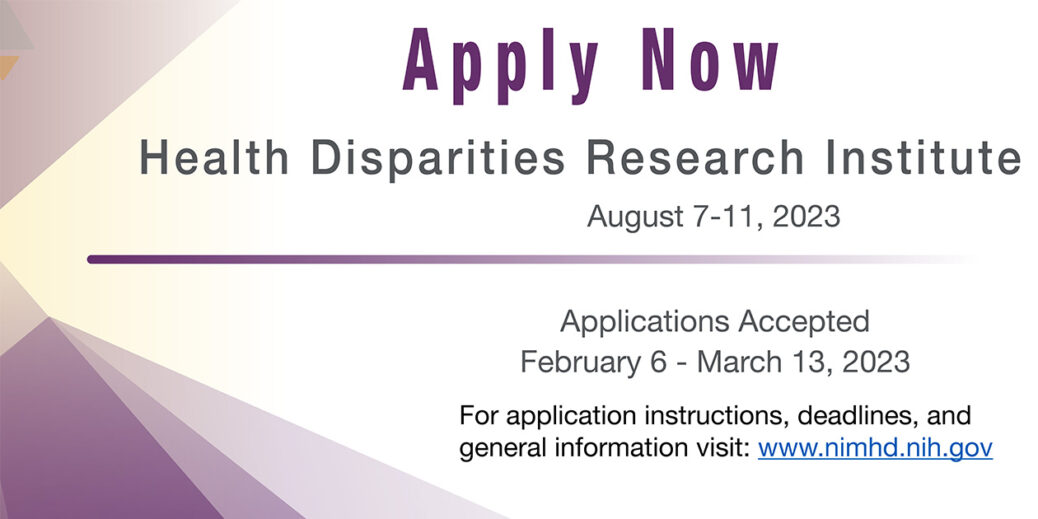
The HDRI aims to support the research career development of promising early-career minority health/health disparities research scientists and stimulate research in the disciplines supported by health disparities science. Applications will only be accepted from individuals who meet NIH’s early-stage investigator (ESI) eligibility criteria.
The HDRI is NIMHD’s flagship annual training program. This unique program includes lectures on minority health and health disparities research, small group discussions, mock grant reviews, and seminars. Program participants have the opportunity to meet NIH scientific staff engaged in health disparities research related to their interests both at NIMHD and across various NIH institutes and centers.
The program features lectures on minority health and health disparities research, small group discussions, mock grant review, and seminars. Institute participants will have the opportunity to meet with NIH scientific staff engaged in related health disparities research across the various NIH Institutes and Centers.
Lecture and seminar topics focus on the etiology of health disparities, research design, methods and measurement, and intervention and implementation research. Participants will receive consultation on developing a research interest into an application—R21, R01, K award—and preparing research strategies and methodologies for proposed studies.
All applications submitted will be reviewed by the selection committee and top finalists will be invited to attend the HDRI.
Participants will be selected based on several factors:
- An NIH Biosketch that includes professional and research experience, educational and career achievements and a record of peer reviewed publications (first or co-authored).
- A personal statement outlining career goals, reasons for participating in the program, and plans for obtaining NIH funding.
- An NIH Specific Aims page that details the scientific premise/background, aims/hypotheses, and proposed methodology that will form the basis of a future NIH grant submission.
- Two letters of reference/recommendation documenting support for the candidate and the future NIH grant submission.
Preference will be given to applicants who can clearly demonstrate that they plan to submit an NIH grant application within one year of attending the HDRI. Additionally, applicants will be selected based on their research accomplishments, research interests, and potential for implementing the knowledge gained during the HDRI into their research program.
Location:
United StatesBenefits
Participants will receive
- consultation on developing a research interest into an application
- R21, R01, K award and
- preparing research strategies and methodologies for proposed studies.
Eligibilities
- This program is intended for early-stage investigators (ESIs) who have completed their terminal degree or post-graduate clinical training within the past 10 years.
- Additionally, applicants must have either a Ph.D., M.D./D.O., Sc.D., Dr. P.H., Pharm.D., Psy.D., D.D.S./D.M.D. or equivalent doctoral degree from an accredited domestic or foreign institution at the time of submitting the application.
- Applications will only be accepted from individuals who are currently in post-doctoral, assistant professor, or comparable research positions.
- Further, applications will only be accepted from individuals who are planning to submit a K or R grant to NIH within the next 12 months.
Individuals from diverse backgrounds are encouraged to apply.
Eligible Regions: Open for All
Application Process
All applications must be submitted via the HDRI application portal by the due date; emailed applications will not be accepted.
All of the following materials must be submitted by the applicant:
- An NIH Biosketch: Read NIH’s Biosketch guidance to learn more about the non-fellowship and fellowship formats.
- A personal statement: The personal statement should outline career goals, reasons for participating in the program, and plans for obtaining NIH funding. Word limit: 350 words.
- A Specific Aims page: The NIH specific aims page should detail the scientific premise/background, aims/hypotheses, and proposed methodology that will form the basis of a future NIH grant submission. Word limit: 850 words, no citations required.
- Two letters of reference/recommendation: The applicant must submit two letters of reference/recommendation (2-page limit each) documenting support for the candidate and the future NIH grant submission. They must be submitted in PDF format, on letterhead, addressed to the HDRI Selection Committee.
Note: There is no other specific formatting required for font or spacing.
Application Deadline: March 13, 2023
Application ClosedOfficial link