

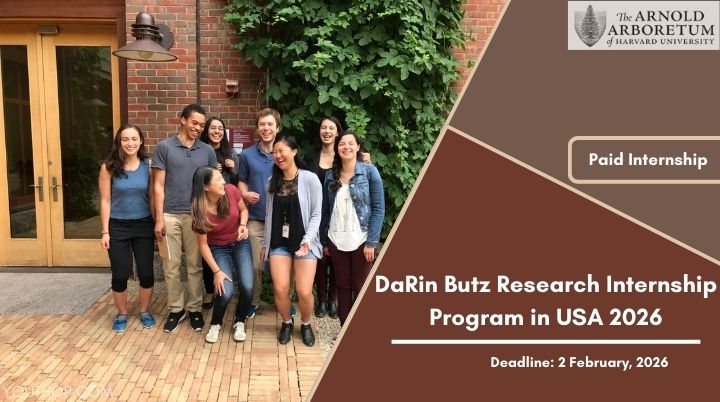
Call for DaRin Butz Research Internship Program at the Arnold Arboretum of Harvard University 2026 is open now!!!
DaRin Butz Interns receive a stipend of $6,250 for the ten-week period and up to $550 for travel expenses.
Youth Opportunities invites you to join your preferred channel to get the latest updates directly to your messenger inbox.
-
- Youth Opportunities: https://m.me/j/AbZTmgEzD1UchDte/
2. Fully Funded Conferences: https://m.me/j/AbZTfhFTiPCnXf2D/
3. Full Scholarships: https://m.me/j/AbbrjbkOMM6I68Cs/
4. Paid Internships/Jobs: https://m.me/j/AbaAskb6jFFnRser/
5. Circle: https://m.me/j/AbY0vVKSPJULUnE4/
- Youth Opportunities: https://m.me/j/AbZTmgEzD1UchDte/
During the ten-week program, DaRin Butz Interns will:
- Work full time for the full ten-week period.
- Perform hands-on-research on a project that the intern help develop.
- Participate in activities with the advisor’s research group.
- Actively participate in weekly reading group and other weekly activities with the other interns.
- Prepare and write research proposal under the guidance of their Arboretum Advisor.
- Attend the end-of-program research symposium and give a 10-minute presentation on their research.
During the internship, DaRin Butz Interns will conduct research in the lab of an Arboretum Advisor. Potential advisors and research projects are listed below. Applicants should choose the research topic they find most interesting and contact a relevant potential advisor (see below) as early as possible to express their interest in working with the advisor during the internship. Potential advisors may conduct interviews prior to acceptance into the program and their lab.
- Adaptation and Speciation in Plants
Under the leadership of Robin Hopkins, John L. Loeb Associate Professor of the Natural Sciences at Harvard University and faculty fellow of the Arnold Arboretum, this research program is focused on the evolutionary processes involved in speciation and adaptation in plants, using diverse tools from population genetics, field biology, genomics, and molecular biology. - Air Pollution and Urban Ecosystems
Under the leadership of Boston University Professors and Associates of the Arnold Arboretum Pamela Templer and Lucy Hutyra, this research program is focused on air pollution in urban ecosystems and its effect on plants, soils, waterways and the atmosphere. This project will be integrated with the National Atmospheric Deposition Program site established at the Arboretum and provides a unique opportunity to analyze real-world data in the environment the student lives in, while taking advantage of the national network that places their findings in the context of national trends. - Evolutionary Biology of Grasses
Under the leadership of Elizabeth (Toby) Kellogg, Associate of the Arnold Arboretum and Robert E. King Distinguished Investigator at the Danforth Plant Science Center, this research program is is focused on the evolutionary biology of important cereal crops and their relatives in the grass family. The goal is to understand and predict how the floral structure of wild species affects climate resilience in wild and cultivated species. - Evolutionary Diversification of Plants
Under the leadership of William (Ned) Friedman, Arnold Professor of Organismic and Evolutionary Biology at Harvard University and faculty fellow and director of the Arnold Arboretum of Harvard University, this research program is focused on the organismic interfaces between developmental, phylogenetic, and evolutionary biology. The Friedman Lab explores how patterns of morphology, anatomy, and reproductive biology have evolved through the modification of developmental processes. - Ecosystem Ecology
Under the leadership of Benton Taylor, assistant professor of Organismic and Evolutionary Biology at Harvard University and faculty fellow of the Arnold Arboretum of Harvard University, this research program focuses on how plants respond-to and influence their environments, particularly in view of global change.
- Global Change
Under the leadership of Michael LaScaleia, Arnold Arboretum Putnam Fellow, this research program investigates the physical and chemical defenses that allow invasive plants to avoid damage from herbivores.
Location:
North AmericaBenefits
This internship includes-
-
Stipend: Interns receive a $6,250 stipend for the full 10-week summer program, which helps cover living expenses while you work full-time.
-
Travel reimbursement: Up to $550 is provided to cover the cost of one round-trip between your home and Boston.
- Hands-on research: You’ll conduct real scientific research on plant biology, ecology, climate change, or related topics, working directly within a research lab under expert mentorship.
- Collaboration & cohort activities: Working alongside a cohort of peers and Arboretum scientists lets you build a network of scientific colleagues.
Eligibilities
Interns selected for the DaRin Butz Foundation Fund Research Internship Program are expected to participate fully in the all aspects of the program and the work-life of the institution with maturity, curiosity, and commitment to learning. They encourage applications from groups under-represented in the sciences. An excellent academic record and participation in a wide range of campus activities are highly regarded, but not the sole criteria for the selection process.
- Must be enrolled in an undergraduate degree program in the life sciences (part-time or full-time at the time of application) leading to a baccalaureate or associates degree. High school graduates who have not yet enrolled and students who have already received their undergraduate degree at the time of application are not eligible for the program.
- Prior research experience is not required.
- Maturity, self-motivation, and willingness to work as part of a team.
- Must be authorized to work in the United States.
- Must be able to work at least 40 hours per week for the entire ten-week term. Vacations are not permitted during the 10-week program (except for official Harvard-wide holidays).
- Harvard University does not provide health insurance for summer interns. All costs of any required health care is the responsibility of the intern.
- Students who have already participated in the program are not eligible to reapply. Those students are encouraged to contact Arboretum staff directly to discuss potential opportunities.
Application Process
To be considered for an internship, online applications should include the following:
- Cover letter. In 1-2 pages, your cover letter should state clearly the following: (i) interest in the program, (ii) interest in the selected research topic, (iii) career objectives and how the internship will help to achieve these goals.
- Resume.
- Unofficial transcript. An unofficial or unencrypted electronic transcript from the institution where the applicant is currently enrolled is preferred. A PDF copy or screenshot of courses/grades is acceptable.
- One letter of recommendation. As part of the online submission, you must send a request to the referee to submit a letter of recommendation (via the request section). The referee will be automatically sent an email with a link to an online submission form where they will upload a letter of recommendation. It is highly recommended that you contact your referee prior to sending the request. Please inform the referee to expect an email from [email protected] with instructions for submitting a recommendation letter. Each referee must upload his/her letter of recommendation via the link by Feb 15.
Application Deadline: February 16, 2026
Application ClosedOfficial link