
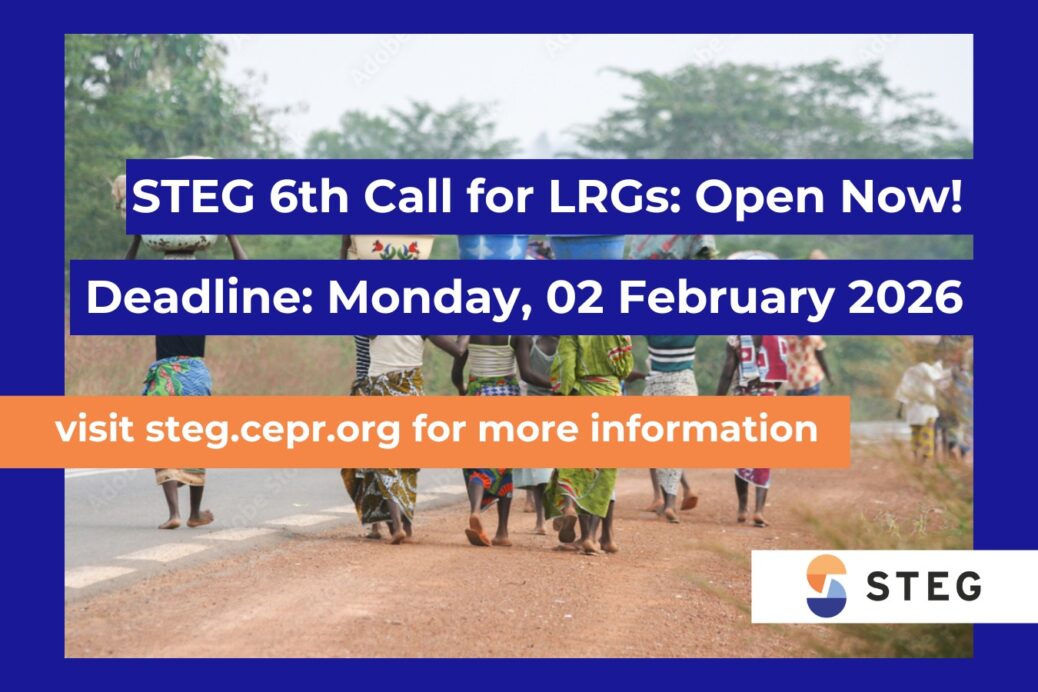
The Sixth Call for Proposals for STEG Larger Research Grants 2026 is open now!!!
STEG (Structural Transformation and Economic Growth) invites applications to the sixth call for proposals for Larger Research Grants (LRGs). LRGs of up to £100,000 can fund research assistance, data collection and/or purchase, and teaching buyouts, or relevant remuneration practices, for the principal investigator and co-investigators from partner institutions. Grants also support travel to field sites, even when secondary data is utilized. They view this kind of travel (with the possibilities for field visits and conversations with policy makers) as particularly important for researchers who lack prior experience in the countries that they intend to study. Please note that cost effectiveness and value for money are important evaluation criteria and submitted budgets must adhere to the LRG Budget Guidelines.
Get the Youth Opportunities iOS App here for the fully-funded opportunities.
For this funding call, the £100,000 cap will be relaxed for projects with extraordinary data collection costs in low-income countries. In order to study questions around structural transformation, productivity, and economic growth in low-income countries, there is a clear need for access to improved data and they recognize the substantial costs related to these projects. As with all projects focused on data collection, they expect the data to be made publicly available by the end of the grant. While no fixed limit has been placed above the £100,000 cap, the additional budget must be within reason and clearly justified.
Youth Opportunities invites you to join your preferred channel to get the latest updates directly to your messenger inbox.
1. Youth Opportunities: https://m.me/j/AbZTmgEzD1UchDte/
2. Fully Funded Conferences: https://m.me/j/AbZTfhFTiPCnXf2D/
3. Full Scholarships: https://m.me/j/AbbrjbkOMM6I68Cs/
4. Paid Internships/Jobs: https://m.me/j/AbaAskb6jFFnRser/
5. Circle: https://m.me/j/AbY0vVKSPJULUnE4/
They aim to issue funding decisions within five months of the deadline for receipt of proposals. An LRG is intended to be completed within 24 months. Please note that contracts should be signed within one month of the return of the final decision, which is also the expected project start date.
Research may focus on broad systemic patterns and processes of structural transformation and growth for low-income countries, in a comparative sense across time or space, or more narrowly defined topics related to one or more of the following six research themes:
- Data, measurement, and conceptual framing;
- Firms, frictions and spillovers, and industrial policy;
- Labor, home production, and structural transformation at the level of households;
- Agricultural productivity and sectoral gaps;
- Trade and spatial frictions;
- The role of the public sector
Other areas of interest may not fit cleanly into any of the themes but are centrally relevant to STEG and are also encouraged. Research in middle-income countries will be considered if it informs growth processes or policies in low-income countries.
STEG is also focused around three cross-cutting issues that are simultaneously relevant to many areas of structural transformation, including the six research themes:
- Gender;
- Climate change and the environment;
- Inequality and inclusion.
Research proposals speaking to these issues will receive particular consideration.
In principle, LRGs cover the same substantive areas, questions, and methodologies as SRGs. However, they are meant for projects, which have greater financial needs due to, for example, greater time requirements, data or research assistance costs. Commensurate with these greater budgets, they are expected to produce either multiple outputs or more fundamental contributions.
They strongly recommend that prospective applicants read the LRG documentation about eligibility, country criteria, preparing an application, how to apply online and the LRG Frequently Asked Questions before applying.
Location:
OnlineBenefits
- Funding: Up to £100,000 for ambitious projects (24‑month max).
- Support: Covers research assistance, data collection, teaching buyouts, and travel.
- Impact: Policy relevance for low‑income countries, especially sub‑Saharan Africa.
- Focus: Special consideration for gender, climate, and inequality.
- Networking: Connects researchers with CEPR’s global network and policymakers.
- Career: Builds credibility, visibility, and future funding opportunities.
Eligibilities
To qualify for the grant, the applicants must be-
- Principal Investigators (PIs): Must hold a PhD or be enrolled in a PhD programme.
- Co-Investigators: Typically PhD holders or candidates; can be based at partner institutions.
- PhD Students: Eligible to apply, but strongly encouraged to collaborate with senior researchers. Solo applicants must submit a letter of support from their PhD supervisor within two weeks of the application deadline.
- Global Participation: Researchers from any country may apply. Proposals must show clear policy relevance for low-income countries, with emphasis on sub-Saharan Africa.
- Institutional Requirements: Grants are contracted with legally registered institutions that meet eligibility criteria. Joint proposals are allowed, provided consortium agreements are in place.
- Restrictions: Proposals involving researchers based at Russian institutions are not accepted due to sanctions.
- COVID-19 Considerations: Projects relying on face-to-face surveys must outline contingency plans and safety measures.
Application Process
This guide explains how to use the online application portal-
- Create an Account: All proposals must be submitted online through our online application portal, CEPR Hub. In order to access the application form, you must first create an account. Once you have signed up, you must verify your account through an email sent to your email address. Once you have confirmed your account, you must complete the registration form. Further details can be added to your profile at a later stage through your account, such as a short biography and a profile image, which will both be visible on their website if your application is successful.
- Applying to an SRG or PhD RG: Applications to SRG and PhD calls can be made through the SRG Application Form. This can also be accessed by selecting “Application (SRG)” through your Hub dashboard. You must then complete the following SRG Application Form. All information submitted must be complete and all proposals and budgets must use the templates provided at the bottom of this page. Proposals that fail to use the correct templates or that have missing or false information or documents containing misrepresentations of facts will be rejected. Upon submission of your application, you should receive a confirmation email. Please note that if you have only very recently created an account, you may not receive the email confirming receipt of your application.
- Applying to an LRG: Applications to LRG calls can be made through the LRG Application Form. This can also be accessed by selecting “Application (LRG)” through your Hub dashboard. All information submitted must be complete and all proposals and budgets must use the templates provided at the bottom of this page. Proposals that fail to use the correct templates or that have missing or false information or documents containing misrepresentations of facts will be rejected. Upon submission of your application, you should receive a confirmation email.
- Resubmitting a Proposal: Resubmissions take place via invitation only. If you are invited to resubmit your proposal, revised proposals can be resubmitted in any future round. During resubmissions you must specify that the proposal is a resubmission by checking a tick box under “Resubmission” in the application form, and include details of the changes made to your proposal in the “Resubmission Details” text box.
Application Deadline: February 2, 2026
Application ClosedOfficial link